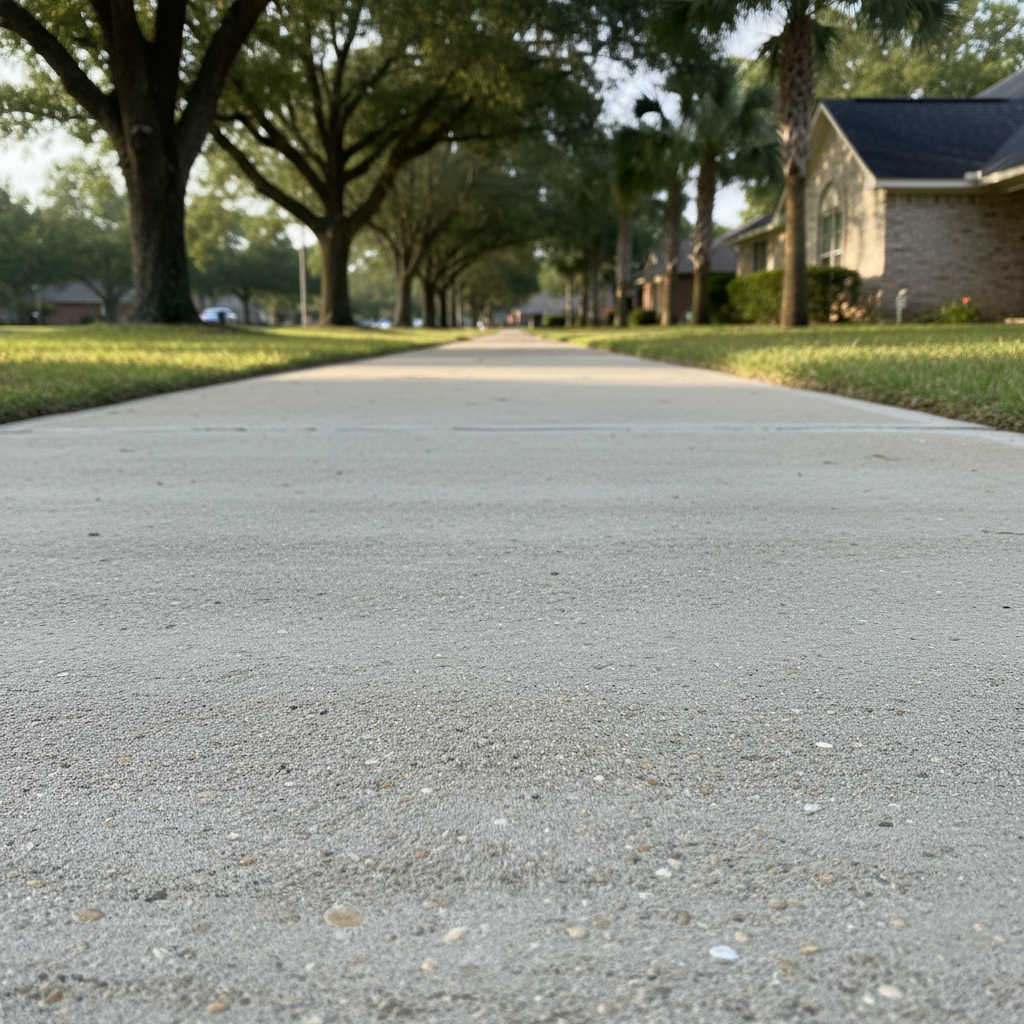
Let us talk about Concrete Sidewalks. Our team has been pouring and fixing these Concrete Sidewalks around Gulfport for many years. We have heard just about every question under the sun about Concrete Sidewalks. New Look Concrete Solutions will give you the straight facts on what you need to know about the Concrete Sidewalks around your home.
Why do Concrete Sidewalks crack and sink, especially here on the Coast?
This is probably the most common question we get about Concrete Sidewalks. Concrete is not elastic. It moves. In Gulfport, our soil and weather conditions are constantly trying to make Concrete Sidewalks move in ways you do not want. You have our coastal Mississippi soil, which can be a mix of sandy and clay-rich compositions. That soil shrinks and swells with moisture changes. If the base under your Concrete Sidewalk is not prepped right, that movement causes cracks.
Then there is the rain. We get about 65 inches of rain a year in Gulfport. Heavy rainfall can erode the soil under your Concrete Sidewalk slabs. This erosion creates voids. When that happens, the Concrete Sidewalk loses its support and starts to sink or crack. Tree roots are another big problem. They will push up Concrete Sidewalk slabs looking for water. If the ground underneath is not stable and well-drained, your Concrete Sidewalk is going to have problems.
How long should a new Concrete Sidewalk last?
A well-installed Concrete Sidewalk, done right, should last you a good 25 to 30 years. Sometimes it will last even 40 years. Some folks even say up to 50 years for a Concrete Sidewalk. This is with proper care and installation. The lifespan of a Concrete Sidewalk really depends on a few things. These things include the quality of the mix as well as how well the sub-base was prepared as well as the curing process as well as how much traffic it sees. If you cut corners on any of those things, you are looking at repairs or replacement a lot sooner. Our team at New Look Concrete Solutions always focuses on getting that foundation right to give you the longest life possible for your Concrete Sidewalk.
What is the deal with those lines in the Concrete Sidewalk? Are they cracks?
Those lines are called control joints or contraction joints. They are there on purpose. Concrete naturally shrinks a bit as it dries and hardens. It is also going to expand and contract with temperature changes. If you do not give the Concrete Sidewalk a place to do that, it will crack wherever it wants. This cracking is usually in a jagged, ugly line. Control joints are essentially planned, weakened spots in the Concrete Sidewalk. These spots encourage any cracking to happen in a straight, neat line. They make the eventual cracks predictable and less noticeable. You will also see expansion joints. These are typically a pliable material. We use expansion joints where a new Concrete Sidewalk slab meets a building or an existing slab. These allow for movement between different structures.
How long does it take for a new Concrete Sidewalk to cure, and when can I walk on it?
This is important information about your Concrete Sidewalk. Concrete does not just 'dry'. It cures through a chemical process called hydration. A standard 4-inch Concrete Sidewalk slab takes about 28 days to fully cure and reach its maximum strength. However, you do not have to wait that long to use it. You can usually walk on your new Concrete Sidewalk after 24 to 48 hours. For light vehicle traffic, like if it is part of a Concrete Driveway, you will need to wait about 7 days. Rushing this can lead to cracks and surface damage to your Concrete Sidewalk.
Can you pour Concrete Sidewalks in the rain?
Ideally, no. It is best to avoid pouring Concrete Sidewalks in the rain whenever possible. Rain can mess with the water-to-cement ratio. This ratio is important for strong concrete. Too much water weakens the mix. It can lead to surface defects like cracking as well as scaling as well as discoloration. If it is a light drizzle, and you have tarps ready to cover it immediately, it might be doable. Heavy rain is a definite no-go for Concrete Sidewalks. The first few hours after pouring are the most important. If rain is expected, we will usually recommend rescheduling to make sure you get a durable, long-lasting Concrete Sidewalk.
What is the best way to maintain my Concrete Sidewalk?
Maintaining your Concrete Sidewalk, especially with our Gulfport humidity and rain, is pretty straightforward. First, keep it clean. Regularly sweep away leaves, dirt, and debris. This prevents staining. It also stops moisture from getting trapped, which can lead to mold or even weaken the Concrete Sidewalk over time. Power wash it once or twice a year to get rid of deep-set grime as well as moss as well as algae. These growths do not just look bad. They make the surface slippery. Also, sealing your Concrete Sidewalk every 2-3 years is a smart move. A good sealer acts as a barrier against water absorption as well as stains as well as the freeze-thaw cycles we sometimes get. This helps prevent cracks. If you see small cracks, address them quickly before they become bigger problems for your Concrete Sidewalk.